An agent takes a property lead from the portals to the first SMS to the owner.
Signature Estates, a real-estate investment operator, did not need another listing dashboard. They needed someone who watches the portals around the clock, remembers each listing's history, and carries a case all the way to the point where a single approval is enough. The agent sets each fresh listing against its full CRM history, scores the seller signal (price moves, relistings, owner versus agent), writes a short memo, and assembles a queue in which every item carries its reason. On the strongest leads it reveals the number and writes a discreet SMS to the owner that the operator approves from Telegram.
Problem, solution, and result
Whoever messaged the owner first won
Whoever messaged the owner first won, and refreshing the portals by hand could not keep up. The operator kept going back to the same pages, telling a new listing from a rehashed one, checking whether the seller appeared willing to talk, and only then deciding whether it was worth writing. The strongest signal got lost among duplicates and listings that looked identical but meant different things.
Four portals watched, one decision queue
The agent watches four portals (OLX, Otodom, Gratka, Morizon) around the clock, so no one has to click through tabs every morning. It remembers each listing's history, tells a new opportunity from a rehashed one, judges whether the seller is open to talking, and hands the operator a short queue: only the listings that need a decision. On the strongest leads it goes one step further, finds the number and writes a ready SMS to the owner that the operator approves with a single tap from their phone.
For whom
Do this at your company if the best deals disappear faster than you can scan the portals, compare history, and message the owner.
Radar, memory, contact, approval
- 01Every listing kept in memory without flooding the operator
- 02The seller signal sets who to approach first
- 03The agent writes the owner SMS itself; sending waits for approval
- Business type
- Real-estate investors and acquisition teams
- Sources
- OLX, Otodom, Gratka, Morizon
- Memory
- More than 6,000 listings with history in the CRM
- Seller signal
- Price moves, relistings, owner versus agent
- First contact
- SMS to the owner, email, or export, on approval
- Stack
- Four portal monitors, a listing CRM, Telegram approvals, and SMS delivery
- Operator approval
- Seller contact waits for operator approval
- Similar system build
- from €6,000 net
- Security
- Every seller contact requires operator approval
- Trace
- CRM record: who approved what, and when
Operator approval
The operator owns every market-facing move
The system can surface a lead, explain its history, and prepare an SMS, email, document, or spreadsheet row. It cannot buy, make an offer, reveal a contact silently, or send anything outside the agreed mode. Every action involving a seller or transaction data waits for the operator's approval.
- Security
- Every seller contact requires operator approval
Source changes need operational controls
Portals change their structure, throttle access, resurface old listings, and hide numbers behind clicks. Early versions created duplicates and treated backfilled history as new supply. The workflow now tracks source health, deduplicates, scans incrementally, checks contacts explicitly, and separates fresh, changed, missing, and historical listings.
Work surfaces
Turn a portal signal into a prepared lead, with contact under your control.
Signature Estates gets a short decision queue rather than a browsing routine: fresh radar matches, changed listings, historical candidates worth revisiting, source issues, and prepared first contacts awaiting approval. An SMS to the owner is approved from the Telegram card in one move, while the CRM holds more than 6,000 listings, radar filters, a hot-lead queue, and the trace of every decision. Telegram handles fast decisions; the CRM holds the proof.
Telegram is where the decision happens. The CRM is the memory and the proof.
Radars
Saved portal URLs are the contract. The system knows which sources to watch, how often to return, and which type of opportunity can move forward.
Telegram
The operator receives a short decision card: why this lead, what changed, and which first contact makes sense. From the card they approve the SMS to the owner, save, or pass, without leaving for the portal.
CRM
The CRM keeps source, photos, listing history, state snapshots, and every prepared contact alongside the decision record: who approved what, and when. It is the system memory and the audit trail behind every approved action.
System screenshots
Six screens from the running system.
These frames come from the running lead-intelligence system for a real-estate operator: Telegram decisioning, CRM listing memory, a prepared SMS to the owner, the morning brief, radars, and the event queue.
Telegram on mobile
The operator decision fits on one screen.
We framed the three mobile captures in a phone and anonymized only the private fields: address, names, channel names, and company names.
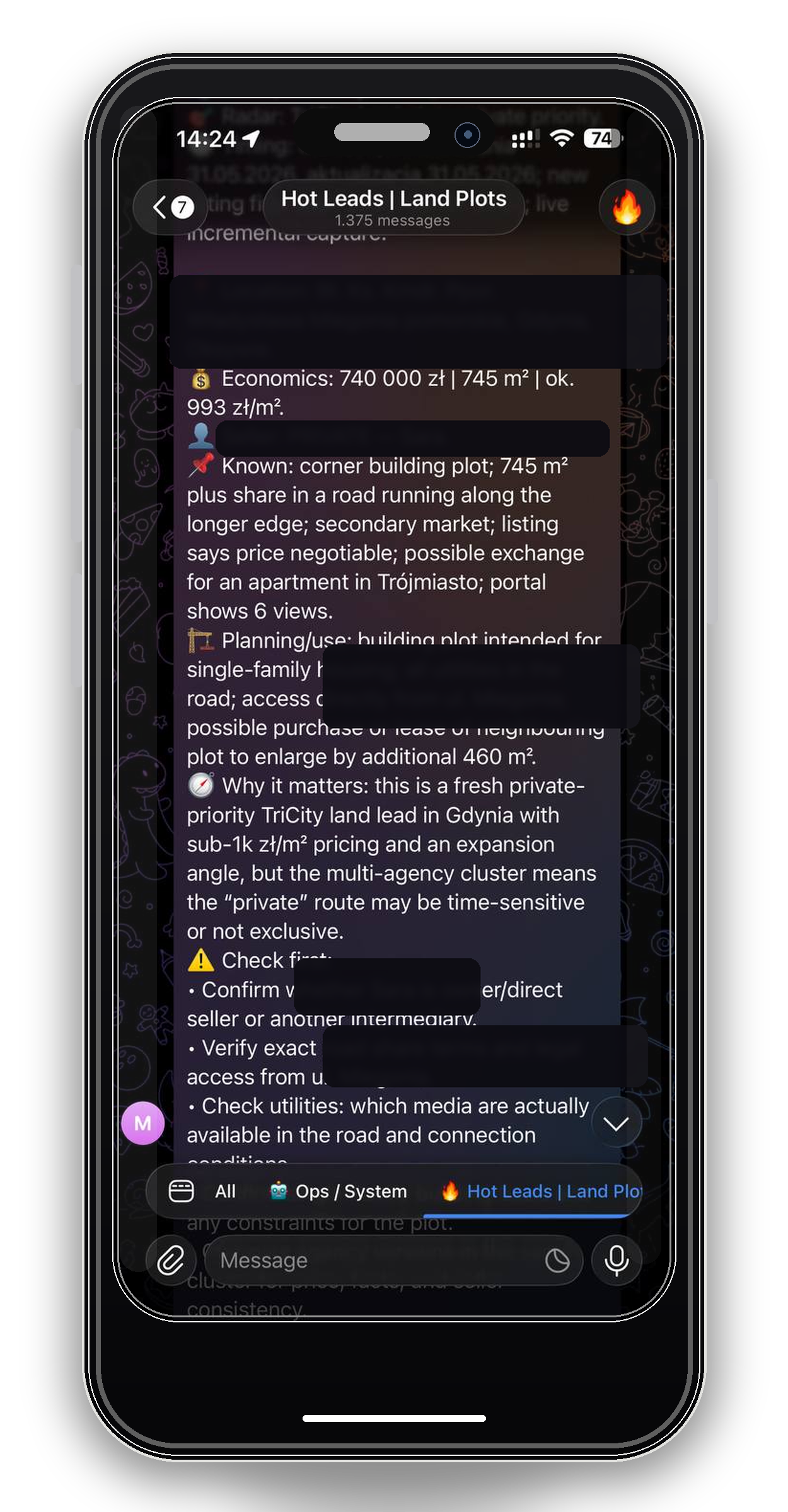
01Top of the lead card: price, floor area, change history, and why the listing is worth checking. 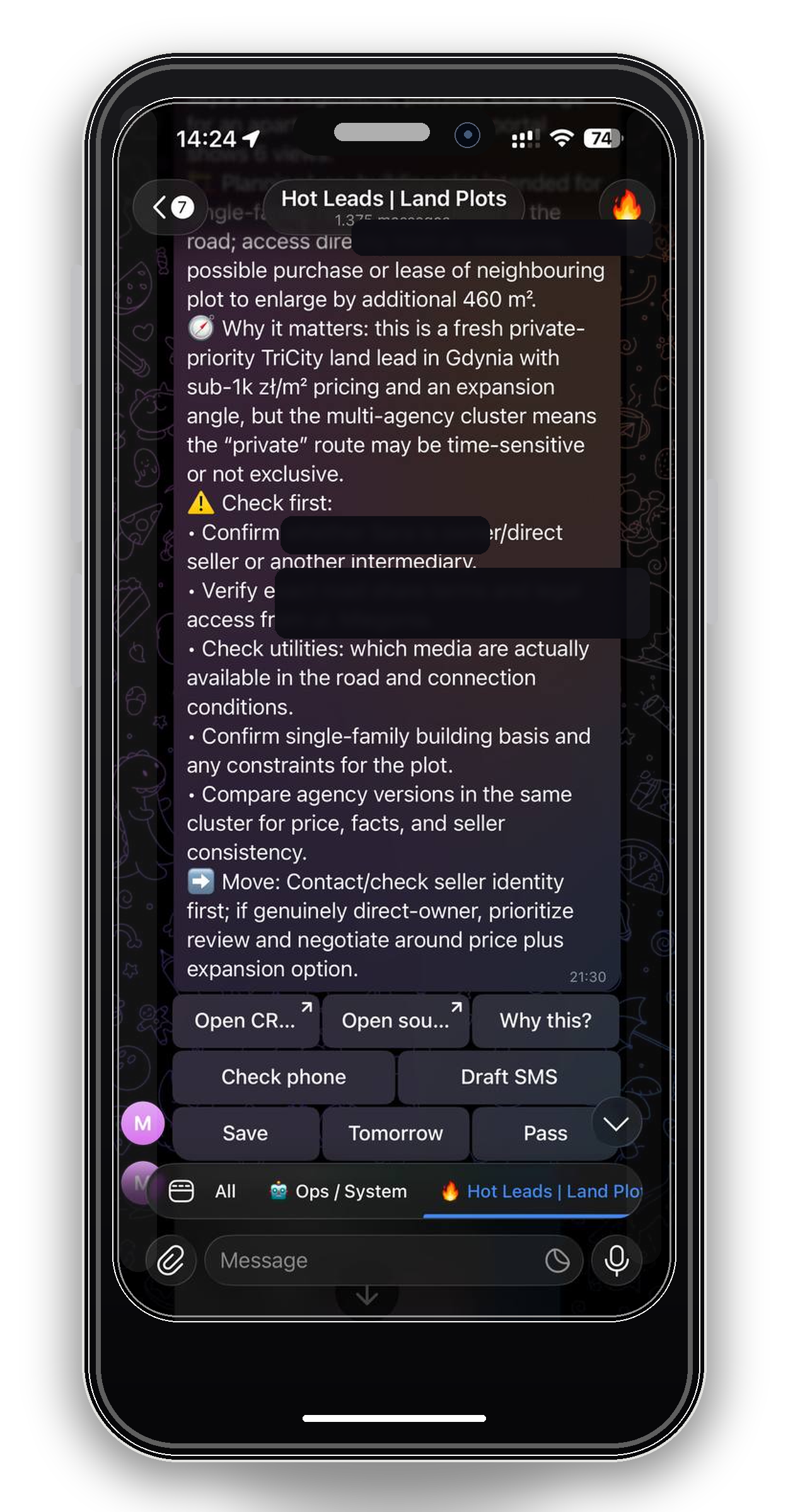
02Bottom of the same card: checklist and operator actions without leaving Telegram. 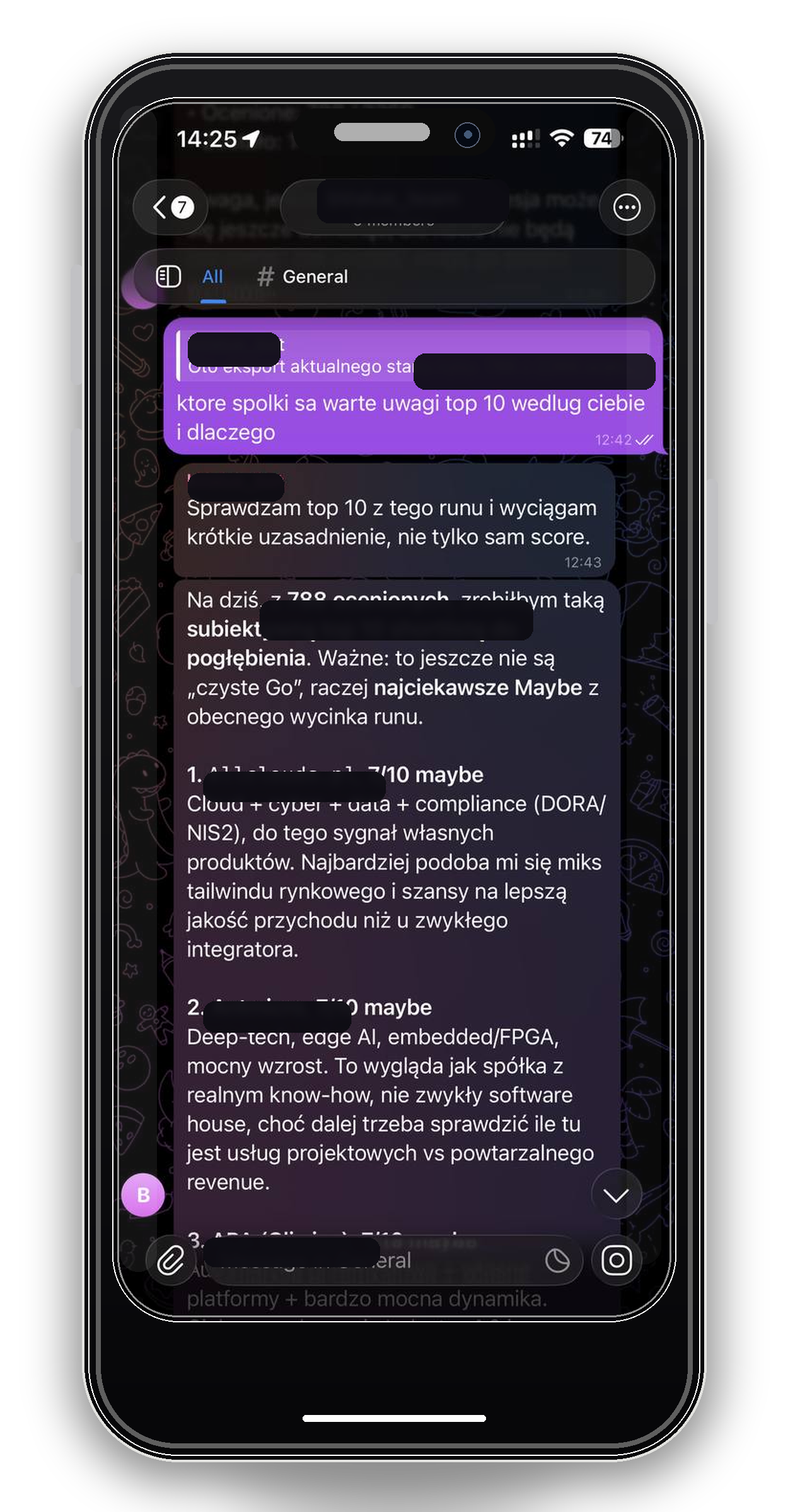
03Team channel after anonymization: the bot returns a shortlist and short rationale for deeper review.
- Screen 01re-lead-intel
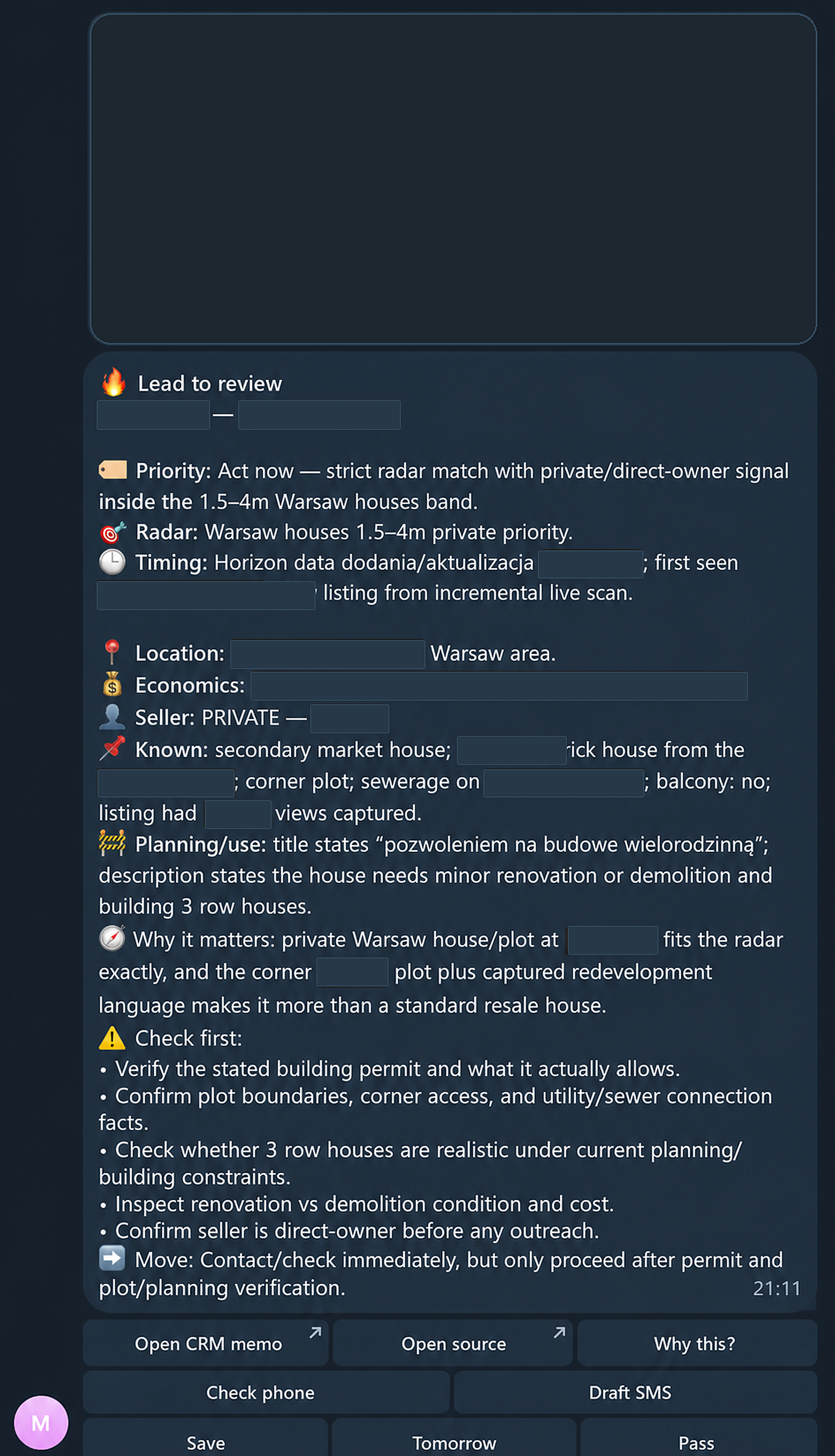
01Telegram card with actions: why this lead, check phone, draft SMS, save, pass. - Screen 02re-lead-intel
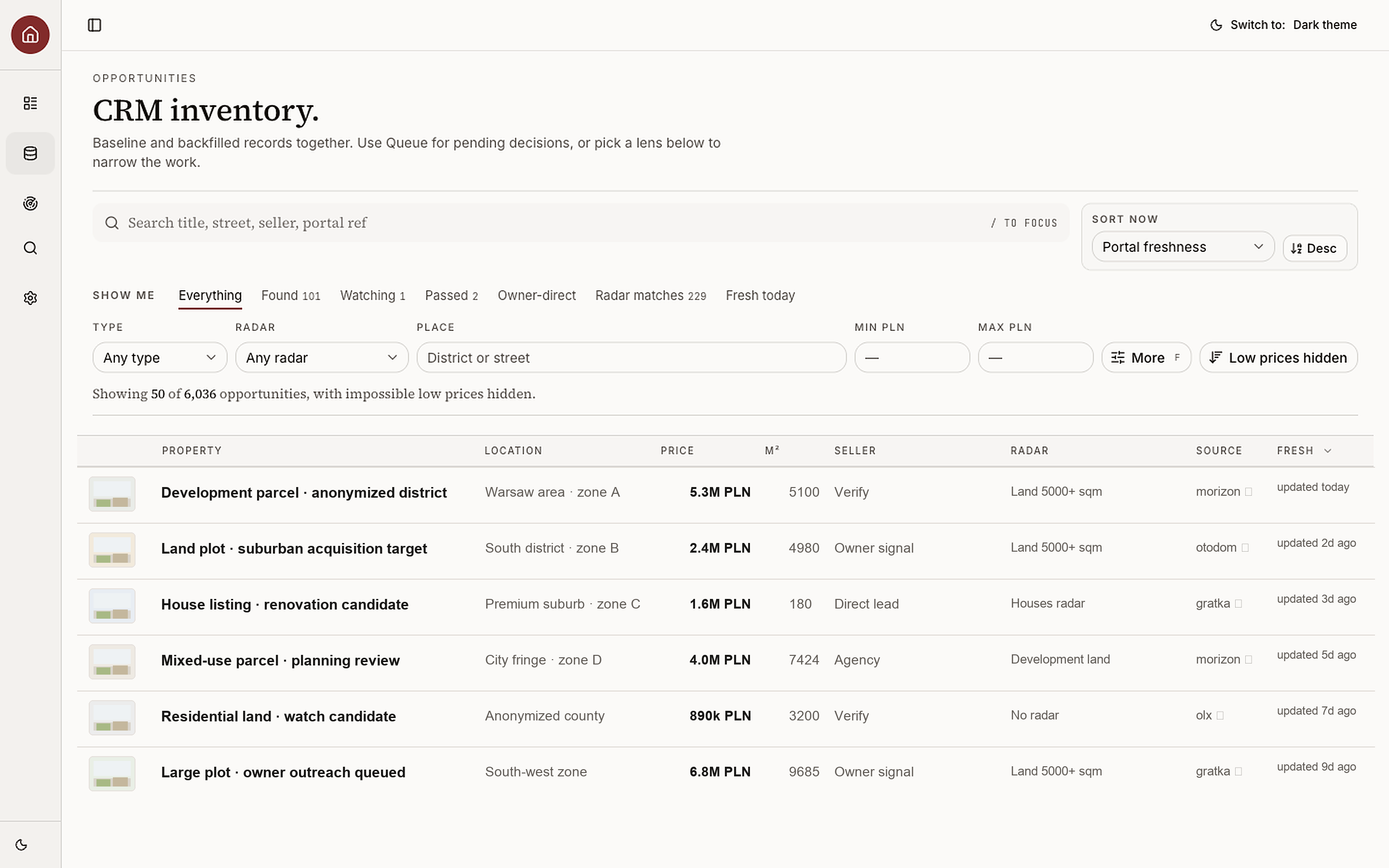
02CRM listing memory: records with source, freshness, radar fit, seller signal, and filters. - Screen 03re-lead-intel
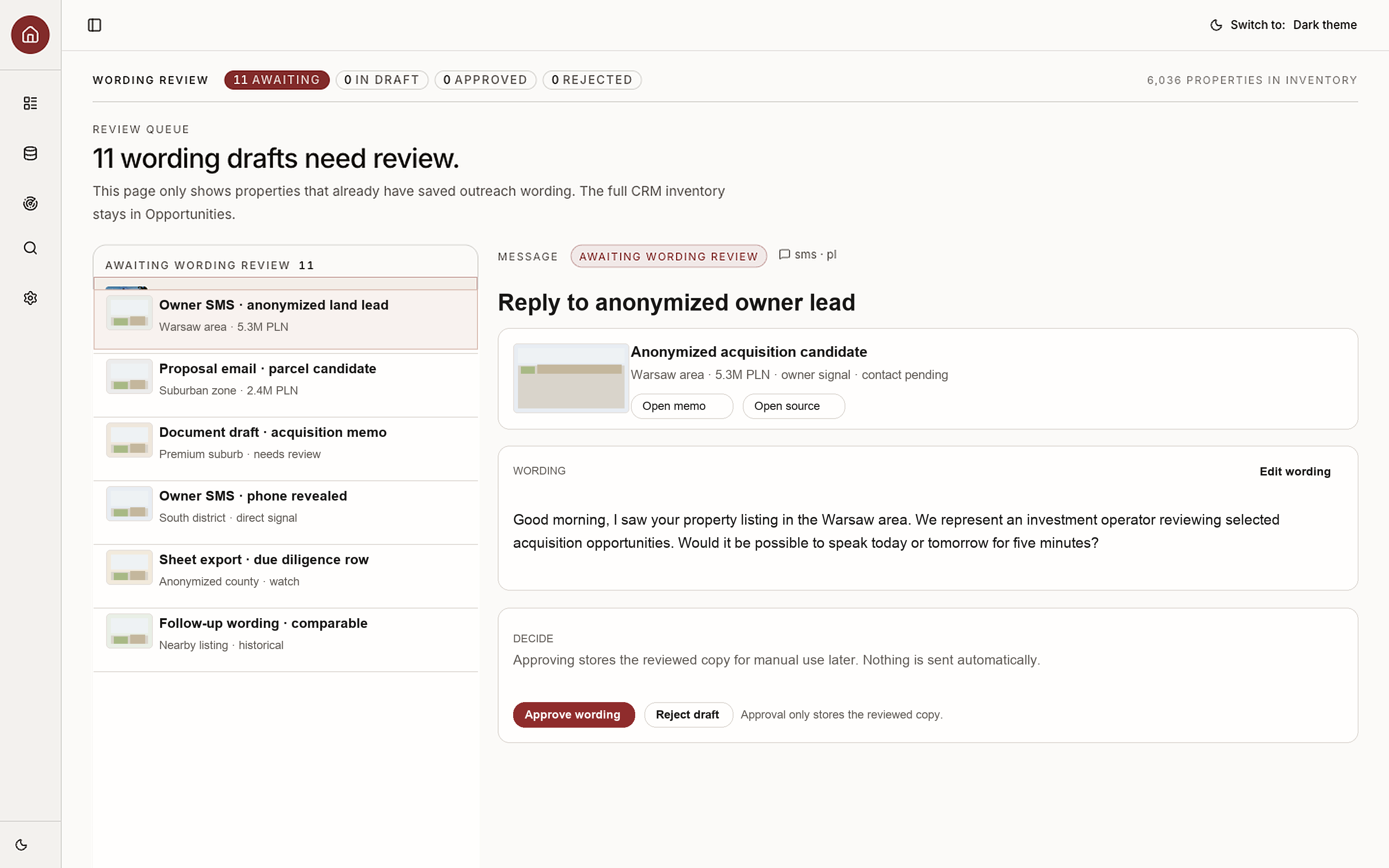
03SMS outreach: the agent writes the message to the owner, and the operator approves the send through an SMS gateway.
Technical details and measurements
Operating loop
How radars turn listings into decisions and a first contact.
The system starts with saved sources, but its value appears later: event selection, listing memory, the operator memo, a ready SMS to the owner, and the trace of every decision.
Saved portal URLs become radars
Scans store listing history; the agent scores the change and the seller signal
Reveals the number and writes an SMS to the owner for approval
Operator approves in Telegram, the CRM holds the decision trace
System architecture
Sources, memory, tools, and consent gates.
The agent watches the market, stores history, calls tools, and stops before actions that require approval.
- 01
Sources
Radars define what can be watched.
Each radar has saved portal URLs, geography, property type, area constraints, seller preference, and notification mode. The agent applies those agreed source contracts to every scan.
- 02
Memory
Old listings become context.
The CRM stores source, photos, change history, freshness, duplicates, and portal state. Backfill does not flood the operator, but it gives context for price, resurfaced listings, and changes.
- 03
Analysis
The agent explains why a lead matters.
The seller signal scores how ready a seller is to talk: whether the price moves, whether the listing returned after disappearing, and whether an owner or an agent posted it. The agent also weighs radar fit, duplicate history, and the next useful step. Telegram receives a short recommendation with its reason; the raw portal record stays in the CRM.
- 04
Consent
Contact, messages, and documents are controlled actions.
On a strong lead the agent reveals the available number and writes a discreet SMS to the owner in their language. Sending starts only once the operator approves it from Telegram. The same goes for a proposal email, a document, or an export: the agent prepares the move, but it does not reveal contacts silently or send anything without the operator's approval.
Why this is agentic
The system moves through several work stages on its own: it watches sources, detects change, uses CRM memory, prepares a recommendation, and calls tools only where the process rules allow it.
- Decides on its own which listing change is an event and which is noise
- Combines portal scans, CRM memory, and a prepared SMS draft in one run
- Separates fresh events from historical listings
- Scores the seller signal from price moves, returns, and poster type
Operating proof
The agent does not stop at an alert. It carries the lead to the first contact.
Most real-estate tools stop at a notification: found a listing, go check it yourself. The value here is further on, in what the agent does after it finds a lead: it remembers the history, judges who is most likely to sell, writes an SMS to the owner, and waits only for approval.
- Memory
Every listing knows its own history.
More than 6,000 listings in the CRM with source, photos, price moves, and relistings after a listing vanished. The agent reads every listing together with its whole past, so it separates a fresh opportunity from old background and spots which seller just dropped their price.
- Contact
The agent writes the owner SMS and waits for approval.
On a strong lead the agent reveals the available number and writes a short SMS in the seller's language. The operator approves it from the phone in one move, and once approved the message goes out through an SMS gateway, from a company number.
- Autonomy
The whole path, one agent.
Watching four portals, detecting a change, reaching into CRM memory, scoring the seller, the memo, and the prepared SMS are one run of work, with no tools wired together by hand. A human steps in once, at the end, at the approval gate.
Client testimonial
The agent watches the portals for us, remembers each listing's history, and catches the sellers genuinely worth a call, with a first message already drafted. Instead of a browsing routine I get a short decision queue, and nothing goes out without me: the contact stays human. It reads like it was built by people who understand the deal, not just the software.

Want to assess a similar process in your company?
- A 30-minute call with the engineer who would lead the work.
- A review of the processes that cost you the most time and money.
- A written summary of what to automate first and the likely cost range.
Times are shown in your own time zone. We work with clients across time zones.
The scan chooses one process to assess, and within 2 business days you receive a recommendation, including when a simpler route is the better fit.