The first pass over the whole list, before the analyst opens a single company.
The investment team lost most of its time to the first pass: normalizing exports, checking fit, looking up registry context, writing the same notes, rebuilding a company's history on every new screen. We built a system that runs that pass for them. It takes the whole list, tens of thousands of companies at a time, and clear exclusion rules stop poor-fit companies before any AI analysis. Each relevant company receives research from KRS registry data, financials, LinkedIn signals, and web context, then a score with thesis and risks against a fixed 11-question framework. The dossier keeps its history. The system prepares the memo, contacts, and outreach draft, while the analyst approves every send. The public screenshots are captures from the running system, with company and account data redacted.
Problem, solution, and result
The prep work ate the time before any judgment
Before an analyst even began judging a company, the time went on tedious prep work: tidying up messy exports, checking whether a company fit at all, digging up context in registries. The same first-pass notes were written from scratch, and when the same company came back in a later screen, its history had to be rebuilt by hand.
Hard rules cut the list, the agent studies the rest
The system takes on the entire first pass across the company list. First, hard rules (financials, scale, ownership structure) filter out what would be rejected by hand anyway, so only companies worth a closer look move on. The agent studies each one like a first-pass analyst: it pulls KRS registry data, financials and LinkedIn signals, answers 11 diligence questions with sources cited, assigns a score, and writes a thesis along with the risks.
For whom
Use this pattern when analysts need first-pass investment judgment across a private-company universe, with a source behind every answer, memory between runs, and an override that sticks.
Upload → gates → dossier → memo
- 01Hard filters drop companies before the model spends a token
- 02Every relevant company has its own sourced dossier
- 03Weak evidence lowers confidence rather than sounding sure
- Business type
- PE/VC funds and investment teams
- Inputs
- Company exports, KRS registry, financials, LinkedIn, web context
- Architecture
- Deterministic gates before AI plus a bounded agent loop
- Surfaces
- Web and Telegram chat (one agent), Slack notifications
- Memory
- Company history across runs, analyst overrides, deal stage
- Analyst approval
- Outreach waits for analyst approval
- Similar system build
- from €3,000 net
- Security
- Companies that fail hard rules are stopped before any model analysis
- Trace
- Score, verdict, override, and stage change, each with source and timestamp
Analyst approval
The analyst keeps the investment decision
The system prepares a first pass, but it cannot decide on an investment, override an analyst, or send outreach. Drafts wait for sign-off. Each company record keeps its sources, data gaps, score history, overrides, and screening trail, so the team can inspect the basis for a verdict.
- Security
- Companies that fail hard rules are stopped before any model analysis
Uneven data must stay visible
The difficult part was keeping weak inputs from becoming confident prose. Exports had missing fields, placeholder identifiers, stale financials, and company names that differed across sources. Validation, gap flags, retained sources, name normalisation, and explicit unknown states keep those limits visible for the analyst.
Work surfaces
Screen more companies without outsourcing investment judgment.
The analyst starts from a ranked pipeline and a sourced dossier. Raw export rows stop at ingest. A screening batch produces stage-level pass rates, verdict buckets, per-company financial context, AI assessment, review controls, and a source trail. Repeated companies carry memory from previous runs, and the memo and outreach draft wait ready for approval, so the analyst's time goes to the decision while the context is already assembled.
The pipeline is the control room. The dossier is the memory.
Run
The control room for the whole batch: where companies stand and what cleared the gates.
Dossier
One company's memory: verdict, thesis, and risks next to what backs them.
Analysis
11 diligence questions across four lenses (business model, market, growth readiness, red flags), turned into a reviewable record with scores and confidence.
Redacted production screenshots
The product surface is the proof.
The product screenshots come from the running system. The operator-chat screenshots come from a mobile work surface. Client and account data, chat workspace identity, and exact batch labels are redacted for public use.
Operator chat on a phone
The analyst runs screening from chat.
We framed three Telegram captures in a phone and redacted company and account data. The analyst asks for a shortlist, checks the product, and expands one company without leaving the chat.
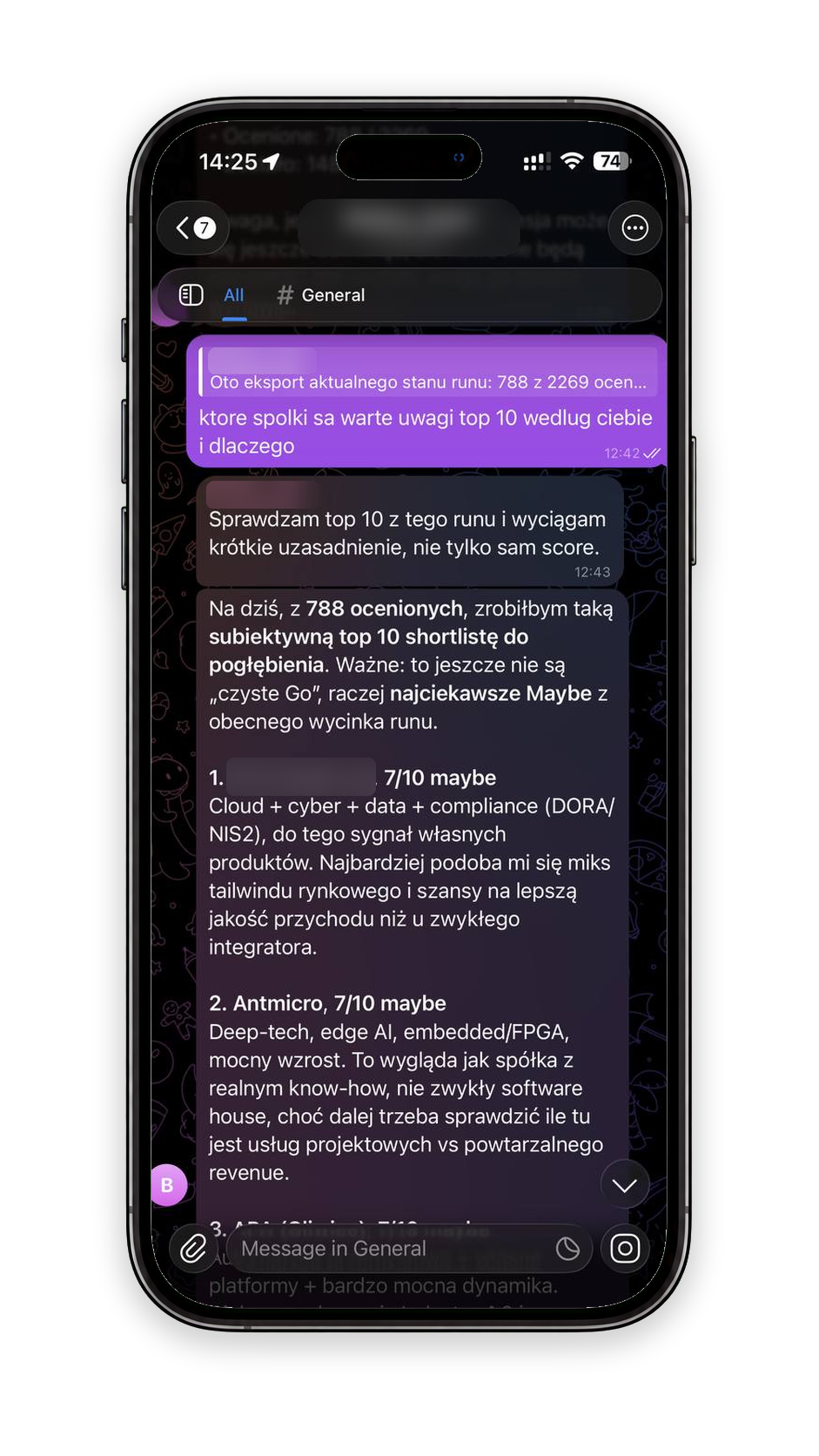
01The analyst asks for a top-10 shortlist and receives a ranked first-pass list for deeper review. 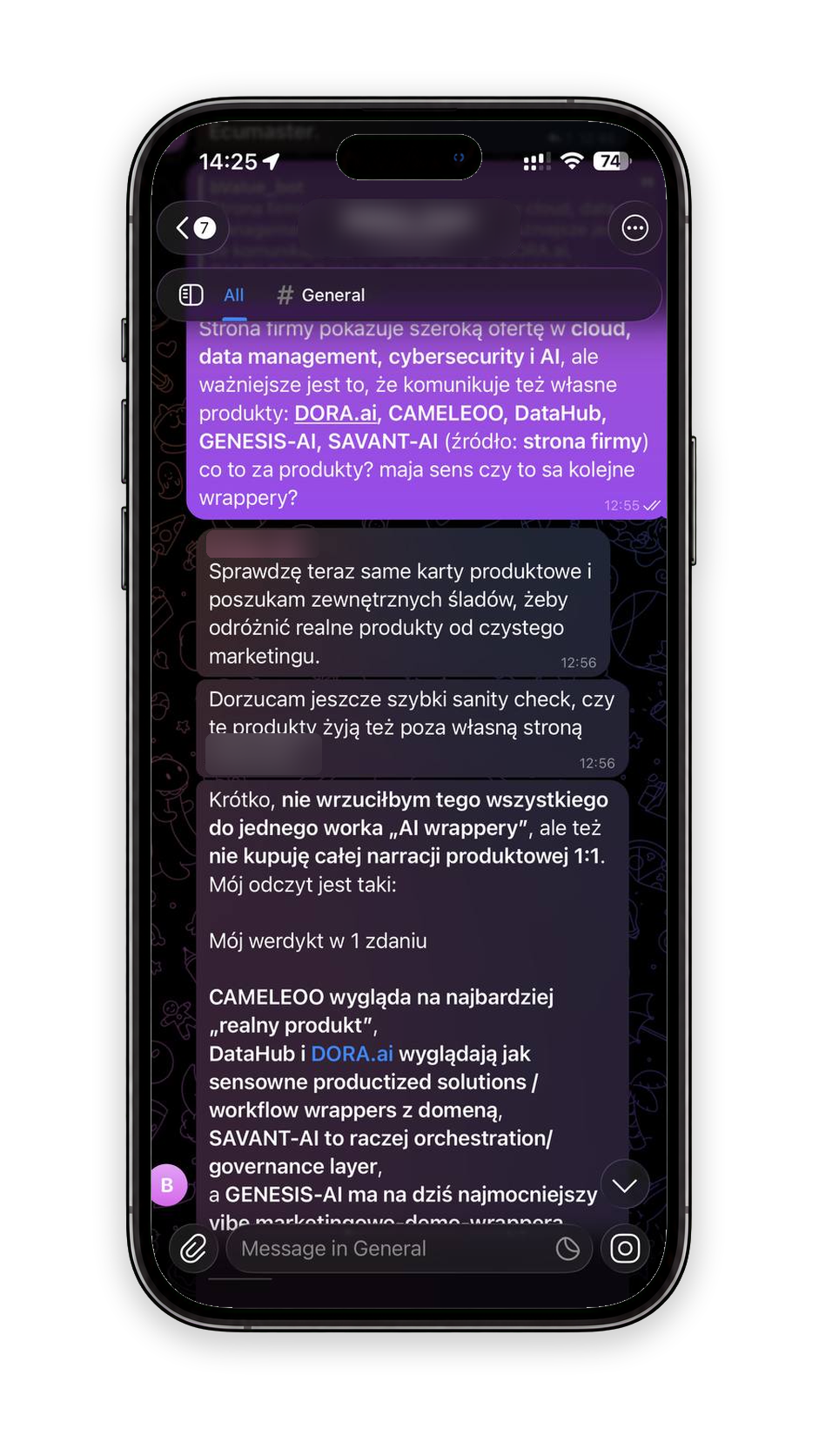
02The agent checks whether product names are substantive productized solutions or just marketing wrappers. 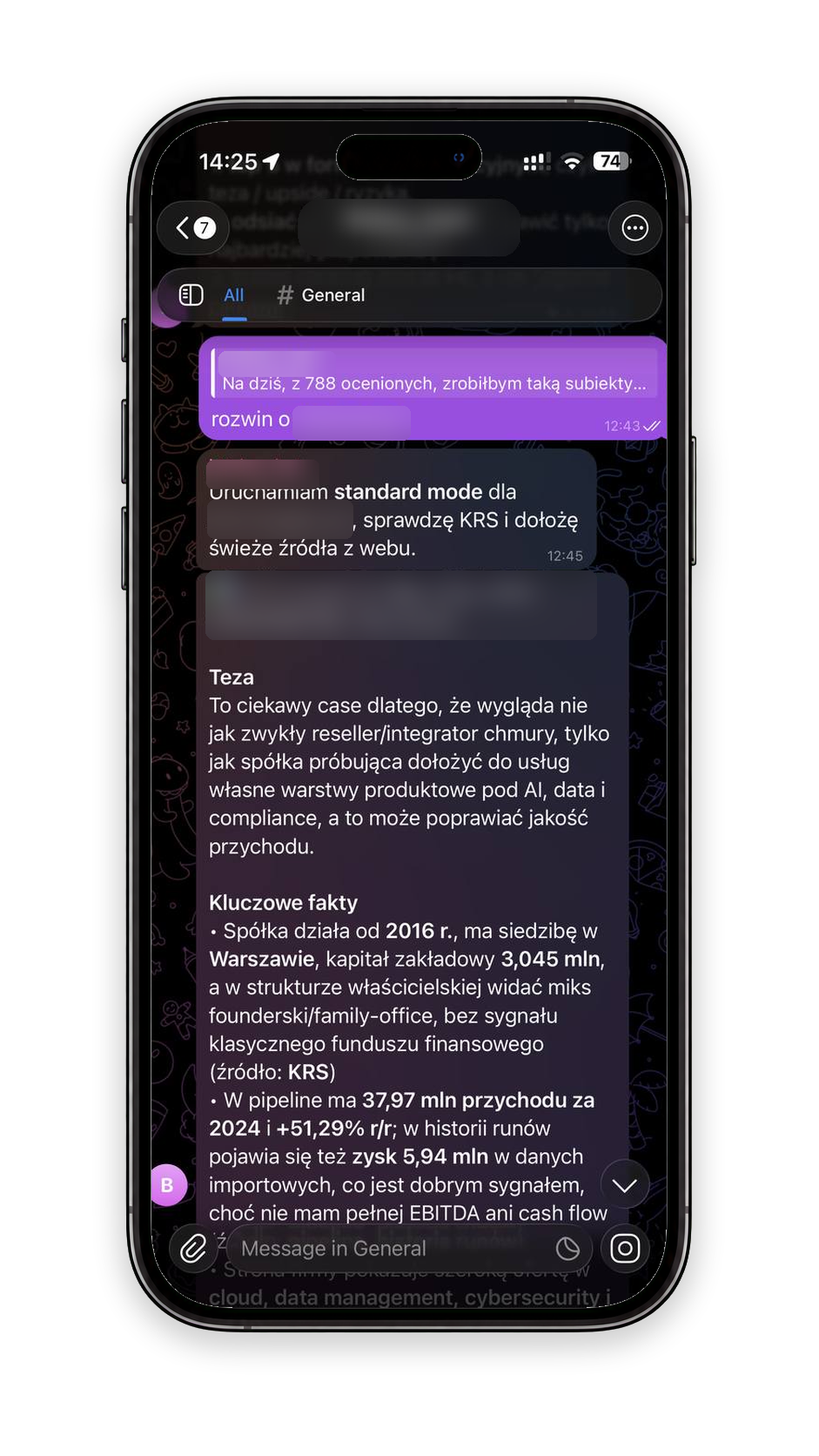
03One company expanded with registry context, revenue signals, thesis, and caveats before review.
- Screen 01vc-investment
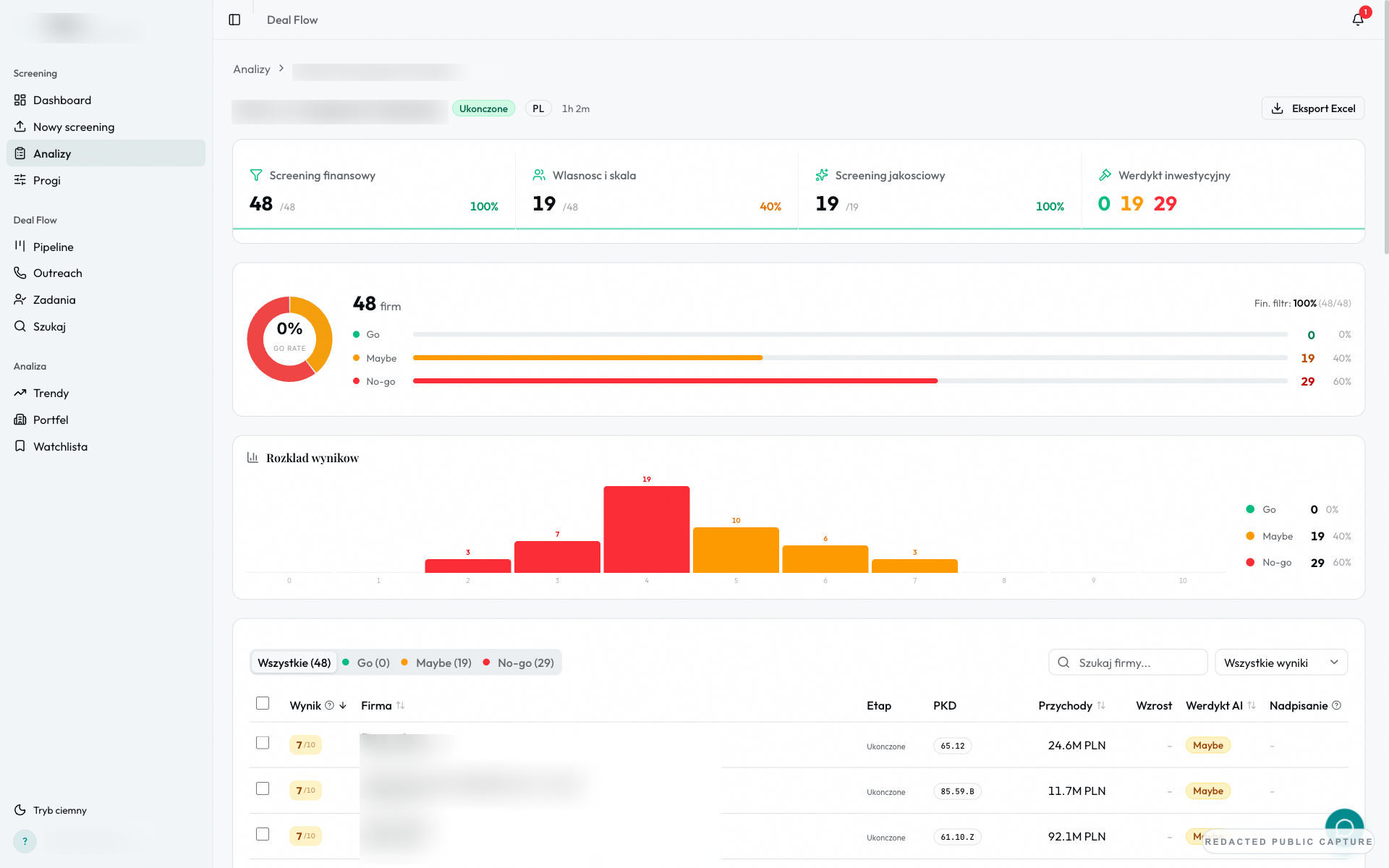
01Run overview: staged gates, verdict distribution, pipeline filters, per-company score, and export control. - Screen 02vc-investment
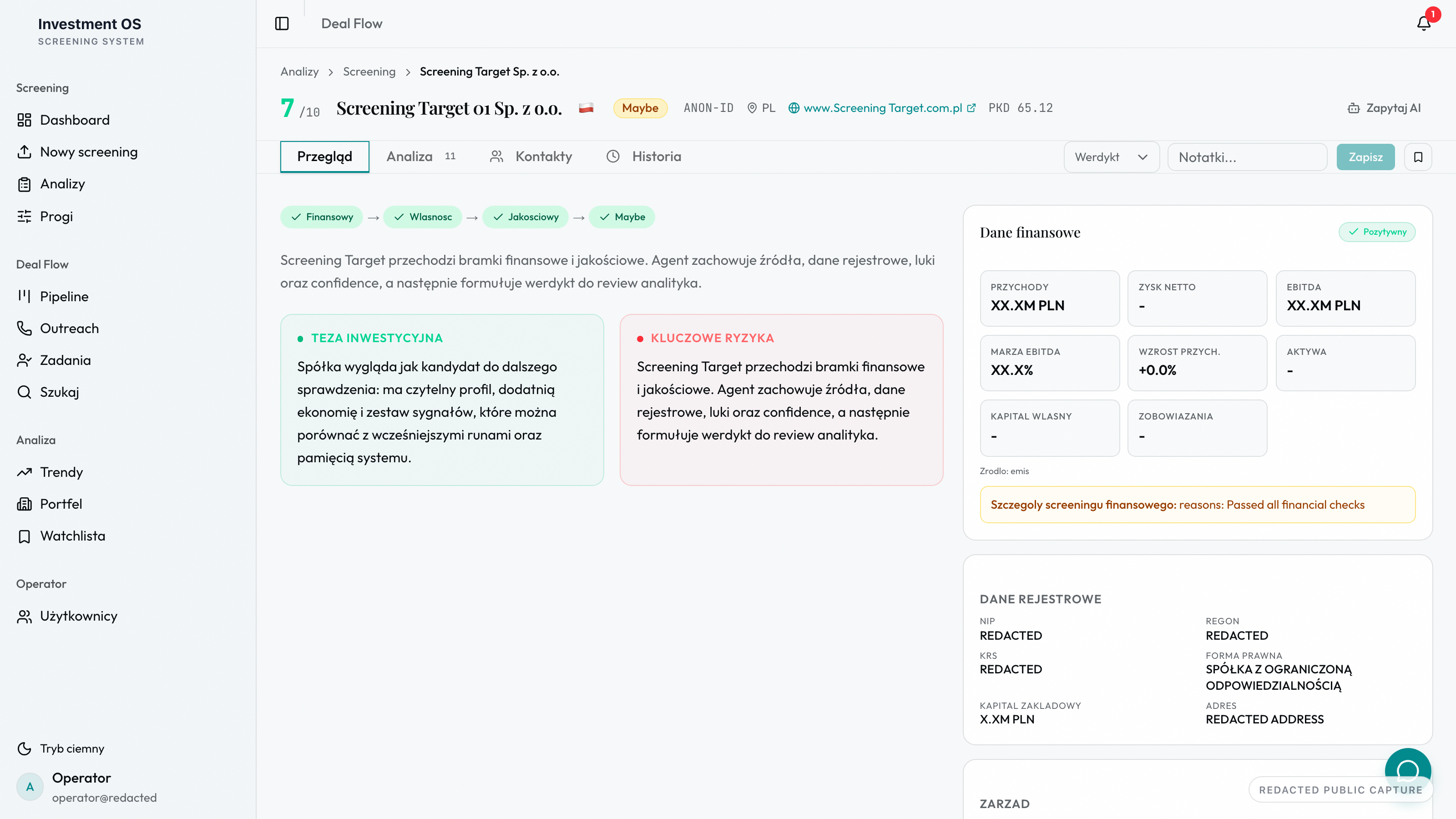
02Company dossier: score, thesis, risks, financial context, KRS registry data, the 11 diligence questions, analyst notes, and review controls.
Technical details and measurements
Operating loop
Gates first. Analysis after.
The system cleans the input, applies the team's criteria as code, and only then sends relevant companies into deeper analysis. The model never sees the companies that fail hard rules.
Company list upload and validation
Deterministic gates: financials, scale, ownership
Research across sources: KRS, financials, LinkedIn, web
11 questions, a score, thesis and risks, a dossier in memory
Memo and outreach draft, analyst approval
Architecture
Gates, tools, memory, and sign-off.
The useful part is the control plane around the model: deterministic gates before analysis, tools inside the loop, durable memory after each run, and analyst approval before business action.
- 01
Ingest
Normalize the company universe
Excel, CSV, and TSV exports can arrive with inconsistent headers, mixed languages, missing identifiers, and stale financials. The system maps the input into a screening schema and drops companies already scored in earlier runs.
- 02
Gate
Run deterministic checks first
Revenue and growth thresholds, margin, debt-to-equity, headcount scale, ownership, and analyst criteria are applied as code. Companies that fail hard rules are documented as such; AI is reserved for companies worth deeper research.
- 03
Research
Use tools, keep the evidence chain
In a controlled loop, the agent pulls the companies to analyze and a fixed investment framework. It enriches each company with KRS registry data, financials, headcount history, LinkedIn headcount and hiring signals, and web context. It then writes the thesis with source references, missing-data flags and confidence language.
- 04
Remember
Carry findings across screens
Company context, prior scores, qualitative answers, known unknowns, analyst overrides, and deal stage are stored on one card, so repeated companies are compared against their own history rather than starting cold.
Why this is agentic
A chatbot summarizes the file you gave it. Investment OS runs a bounded workflow with state, tools, memory, scoring, exception handling, and human approval.
- Deterministic gates before AI
- Tool-backed evidence collection
- Long memory per company
- Review, override, and audit trail
Operating proof
What the run records about every company.
Every score stays in the system with its sources, its missing-data flags, and its override history. Research runs across four signal classes (registry, financials, LinkedIn, web context), and the analyst holds the last word.
- Work
AI starts only after the structured screen.
The first pass is deterministic: input mapping, financial checks, scale filters, ownership signals, and analyst criteria. Only the gated subset reaches the model, so run cost scales with the number of companies that clear the gates.
- Escalation
A weak input becomes a review flag.
Missing identifiers, conflicting names, stale financials, low-confidence context, and hard-rule failures are surfaced as review conditions rather than being smoothed into confident text.
- Measurement
The run is inspectable at every stage while it works.
Operators see stage gates, pass rates, verdict buckets, scored and unscored companies, and export state. A large run takes hours and stays visible as it goes, so screening coverage is never hidden in the background.
- Trace
Every score can be reconstructed and defended.
The score, the verdict, each analyst override, and every stage change are saved with source and timestamp. The team returns to the evidence the verdict stood on rather than trusting a number with no history.
Want to assess a similar process in your company?
- A 30-minute call with the engineer who would lead the work.
- A review of the processes that cost you the most time and money.
- A written summary: a possible direction, missing information and the next step.
Times are shown in your own time zone. We work with clients across time zones.
The scan chooses one process to assess, and within 2 business days you receive a recommendation, including when a simpler route is the better fit.