Custom supplier portal or SaaS?
A custom supplier portal deserves consideration when access fees grow faster than the value of the features the company uses. Compare the full cost of operating and changing the system, including migration, maintenance and user support.
Syntalith
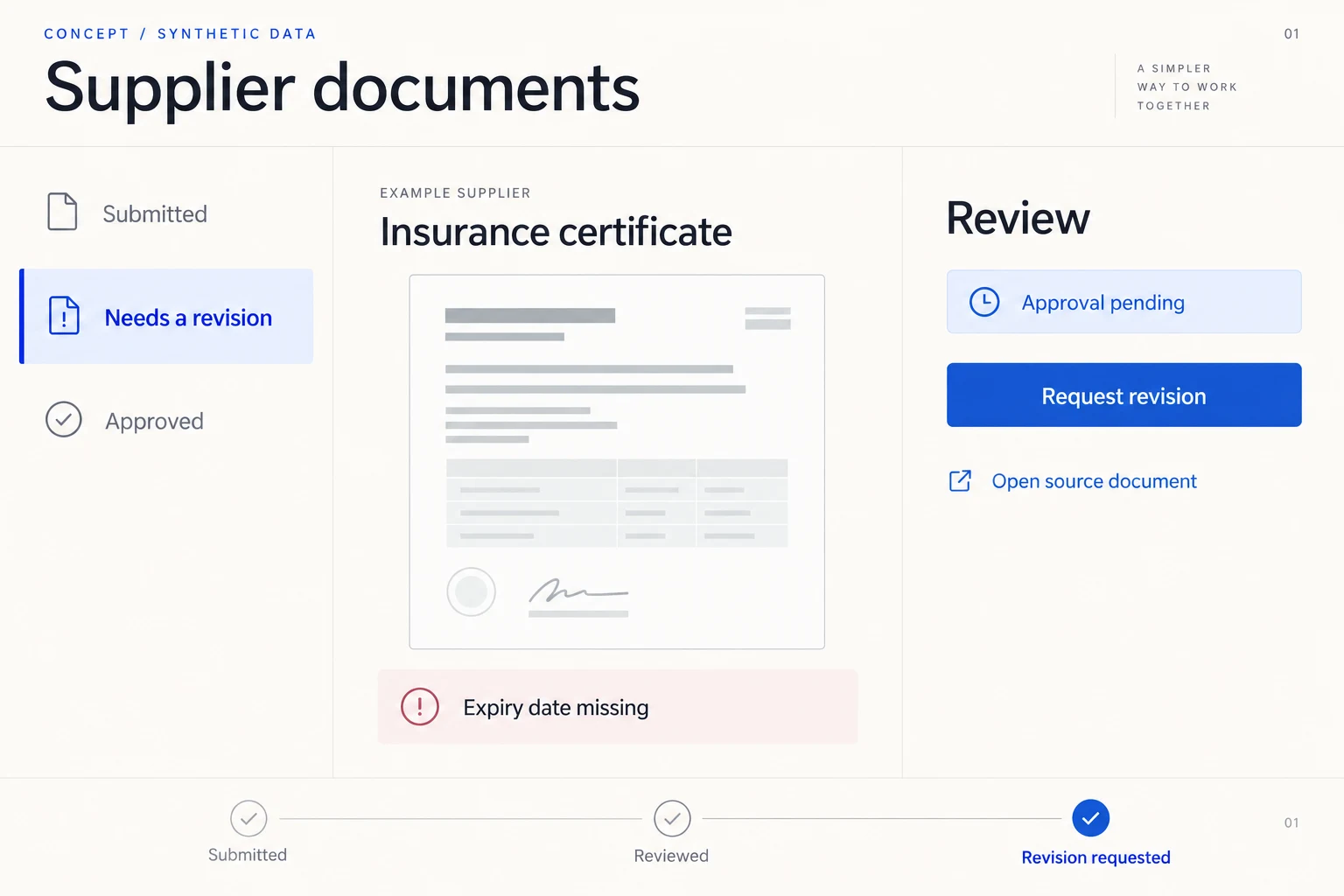
The required workflow may be simple: a supplier submits a document, sees its status and responds to a missing item. Yet access may be bundled into a broad platform whose pricing grows with occasional external users. Before committing to custom development, compare that access requirement with the other options available.
Understand what the current bill buys
Separate actively used features from those merely included in the plan. Look at supplier activity, administrator effort and the integrations that keep the process working.
Check renewal options as well. Can the company change plans, reduce scope or negotiate external-user terms? A commercial adjustment may solve the problem faster than a software project.
Retool’s 2026 customer research reports interest in replacing software functions with custom applications. Its sample consists of customers and builders, rather than a representative cross-section of businesses. It does not prove that a custom portal will be less expensive.
Replace a defined workflow
An initial scope might cover supplier documents, missing items and approval status. It does not need to reproduce an entire procurement suite. Negotiation, purchasing and payment functions can remain in existing systems.
| Option | When to consider it |
|---|---|
| Renegotiate | The product fits but the commercial terms do not |
| Switch SaaS products | Requirements are standard and another offer fits |
| Extend the current system | One interface or workflow is missing |
| Build a focused portal | A bounded process needs specific data and rules |
AI is optional. Access, status tracking and notifications may be ordinary application features. Document interpretation can be evaluated separately if it solves a real problem. Adding a model should have its own justification.
Compare the same period and scope
For the current product, include subscriptions, add-ons and workarounds. For custom software, include discovery, development, migration, hosting, maintenance, future changes and support.
The custom option’s total cost is its initial delivery and transition cost plus operation over the evaluation period. A difference matters only if both options deliver the required quality and continuity.
Do not compare one year of subscription fees with a one-time programming quote. The application will still need updates and an owner for access and incidents. Work previously performed by the SaaS provider needs a new home.
For a US buying group, make currency, contracting entity, support hours and responsibility for infrastructure explicit. None of those should be inferred from an English-language proposal.
Migration belongs in the product scope
Check export access to documents, statuses, history and supplier relationships. A CSV export may omit attachments or decision records required to continue the process.
Establish how suppliers obtain access and where they ask for help. During transition, the team needs a clear rule for which system owns each case. Plan backward from the renewal date, allowing time for acceptance work and corrections.
Code ownership, data ownership and the ability to change providers also need contractual clarity. A broad promise that the system will be “yours” does not answer those questions.
Test the complete set of roles
Acceptance should cover suppliers, account owners, approvers and administrators. Examine cross-supplier access, corrected documents, revoked accounts and decision history. Ask the provider to walk through these situations using accounts with different permissions.
Measure task completion and residual administration. License savings lose value if staff spend each day repairing the workflow. Include outages and recovery responsibilities in the operating agreement.
Scoping the work with Syntalith
Syntalith’s custom application services can assess whether a focused application, an extension or an existing product fits the requirement. A proposal should identify functional boundaries, migration, acceptance and maintenance. The initial assessment would establish whether this proposed replacement makes sense for your suppliers and internal team.
Current price information is on the pricing page. Bring the features in use, user activity, renewal date and integration needs to the initial discussion. A description of the process is enough to begin; access credentials are not needed for that conversation.
Assess whether custom software makes business sense
Compare your subscription, required features and workarounds with the cost of development, migration and ongoing ownership.
Explore custom applications