Blog · Published · Updated
A custom ATS with a voicebot: 3–4 hours less work per candidate
Short answer
For the HR team of a technology company we built a custom ATS with a voicebot for pre-screening: the recruiter adds the CV and sends a link, the voicebot runs the approved conversation, and the result with its sources goes to the recruiter, who makes the decision. The team works about 3 to 4 hours less on each candidate.
How we workDetails ↓
- 01Call30 minutes with an engineer, free
- 02PrototypeA working system on your process and data, free
- 03ImplementationTarget and fixed price in the contract; 50% at signing
- 04Acceptance50% once the agreed target is met
- net per application, fixed price before contract
- from €3,000
- from signing the contract to acceptance
- 4–10 weeks
- free prototype on your documents
- €0
We belong to the OpenAI and Anthropic partner programmes and learn through their official courses. What this means ↓
Author: Syntalith · 5 min read
Statistics
Recruitment and AI: statistics 2026
3–4 h
less HR team work per candidate after rolling out a custom ATS with a voicebot for pre-screening at a technology company. Syntalith implementation result, client under NDA.
2 Dec 2027
According to the European Commission (2026), the AI Act rules for high-risk systems in Annex III, including systems for selecting candidates, apply from 2 December 2027.
2 Aug 2026
According to the European Commission (2026), the transparency obligations in Article 50 of the AI Act, including telling a person they are talking to an AI system, apply from 2 August 2026.
90%
According to the European Commission (2026), 90% of EU companies using AI say people take the decisions.
Source: European Commission, Flash Eurobarometer 578 (2026) ↗
Figures checked: 22 October 2026
- 01CVthe recruiter adds the candidate
- 02Planthe recruiter approves the questions
- 03Conversationthe candidate knows they are talking to a voicebot
- 04Resulta transcript and sources for every answer
- 05Decisionthe recruiter assesses and chooses the next stage
What the HR team gained from candidate screening with a voicebot
- About 3–4 hours less work per candidate.
- A simple process: the recruiter adds the CV and sends the candidate a link. The voicebot runs the pre-screening, and the candidate talks when it suits them, while the link is valid.
- People still run the most important interviews. They come to them with the result of the first conversation, the transcript and the sources.
- The custom ATS replaced an expensive SaaS system the team used to run recruitment in.
- Every decision keeps the question plan, the transcript and the version the recruiter accepted. That is the trail you need when a candidate asks what a decision was based on.
Before the conversation: the recruiter approves what to ask
1. Role requirements. The recruiter starts with the job requirements. Every requirement has a source you can go back to.
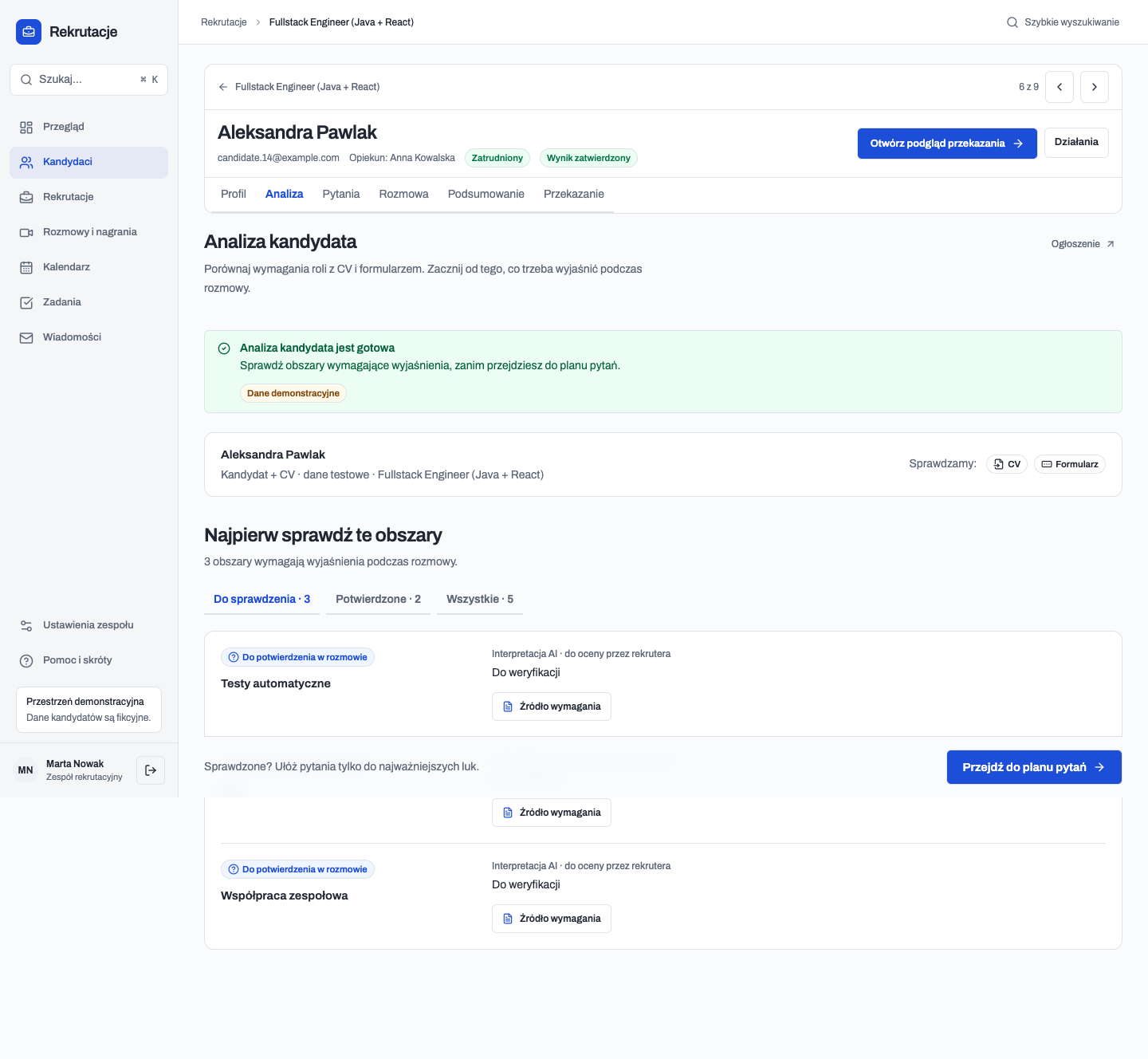
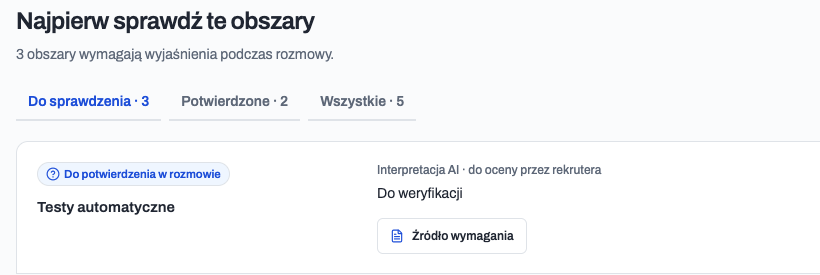
2. Candidate analysis. The recruiter adds the CV. The system compares it with the requirements and the form, points to areas to check in the conversation and shows the source for each. The AI's interpretation is marked as material for the recruiter to assess.
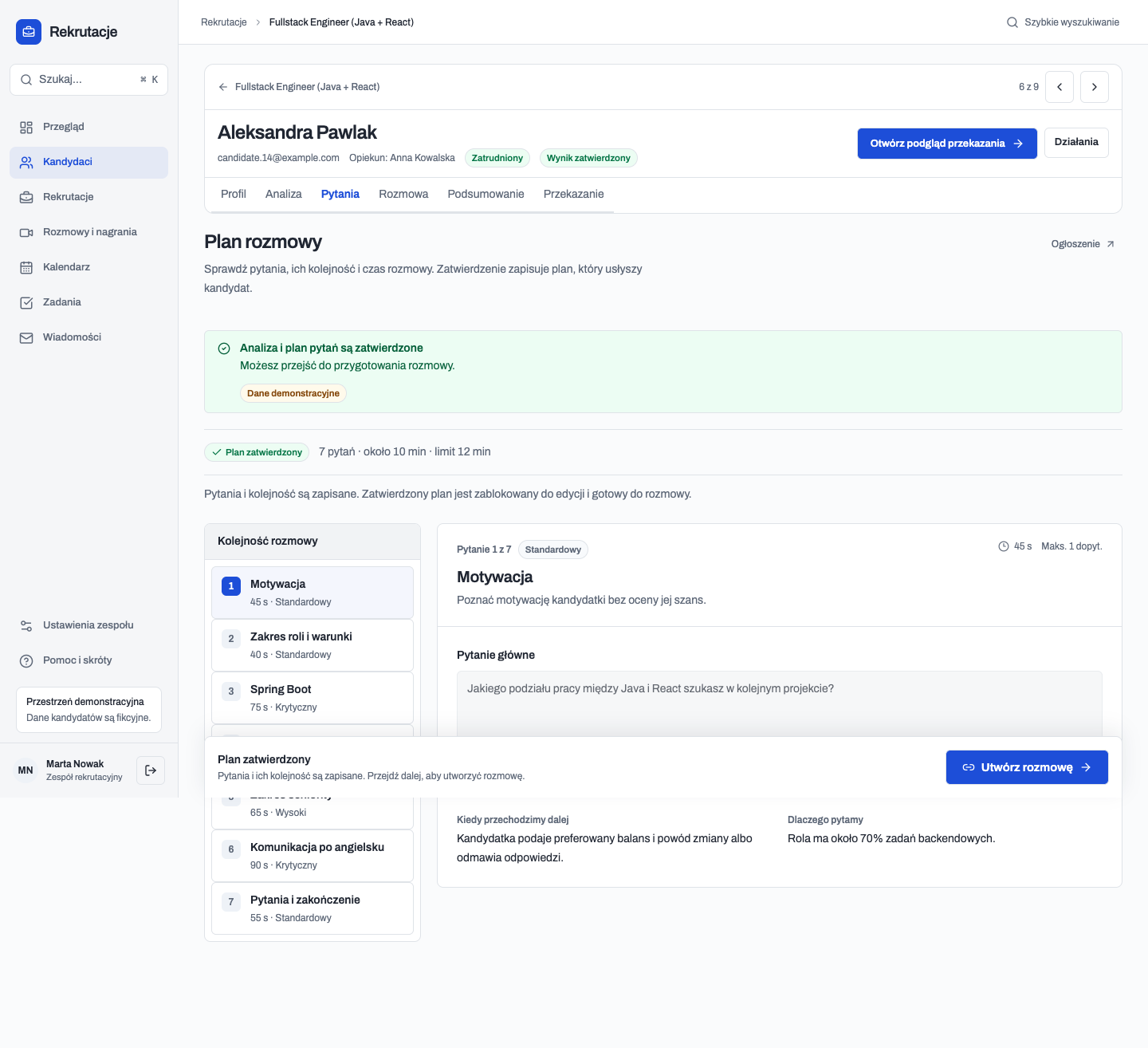
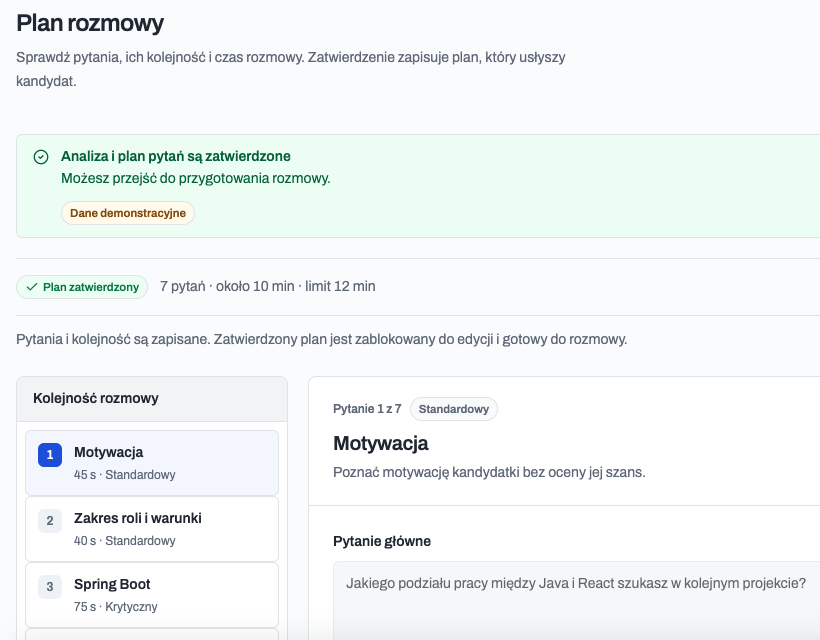
3. Conversation plan. The recruiter reviews the questions, their order and timing. Every question has a priority, a limit on follow-ups and a recorded reason for asking it. The approved plan is locked for editing, so the candidate hears exactly these questions.
The conversation: the candidate knows who they are talking to
4. Invitation. The candidate gets a one-time link. They install no app and need no camera.
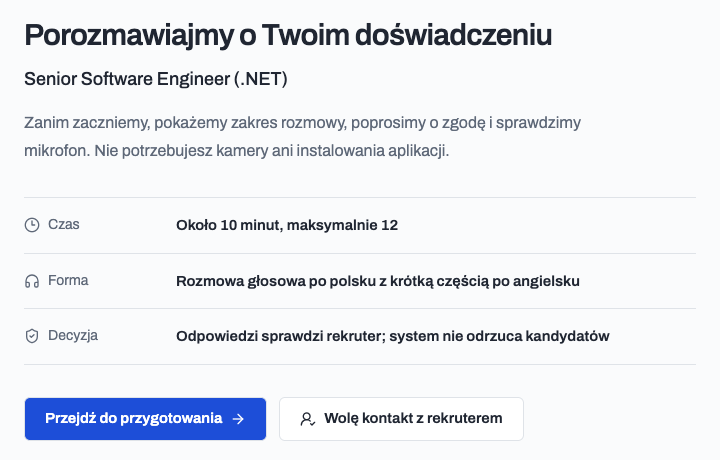
5. The voicebot conversation. The voicebot runs a voice conversation in Polish, with a short part in English. It takes about 10 minutes, 12 at most.
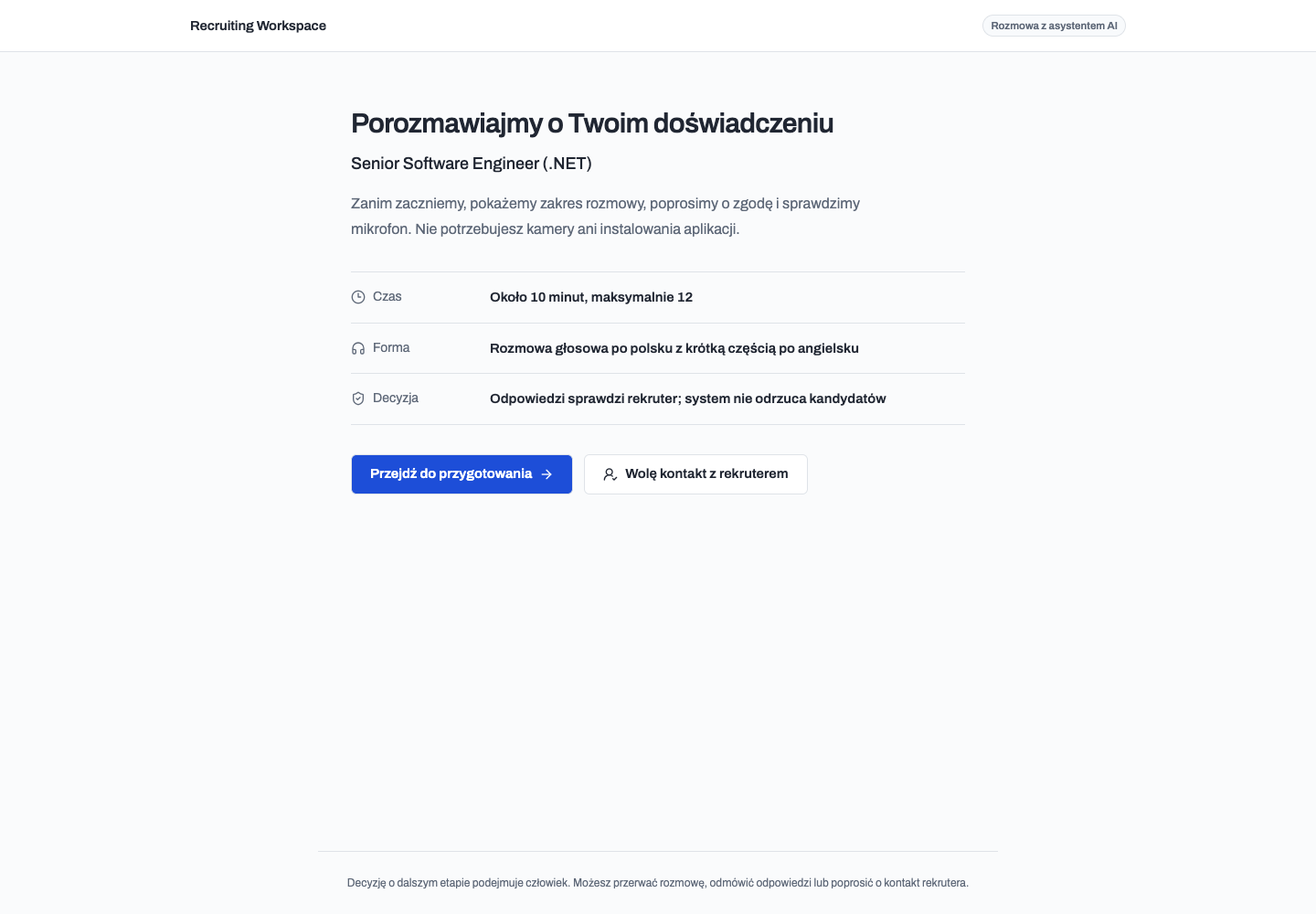
The start screen is labelled as a conversation with an AI assistant. Before the conversation begins, the candidate sees its scope, gives consent and checks the microphone. The screen also says plainly that a recruiter will check the answers, and that the system rejects no candidates. At any moment the candidate can stop the conversation, decline to answer or ask to be contacted by a recruiter.
After the conversation: a result with sources and a person's decision
6. Result. The system prepares a result with references to the candidate's statements and to the sources. The recruiter checks the transcript, corrects the result and only then approves it.
7. Hand-over. The approved result is passed on through a link with an expiry date. The transcript and the recording have to be ticked separately, and the link can be revoked.
Recordings are encrypted on disk. In the configuration shown, recordings of new conversations and public links expire after 7 days. The person who gets the link sees the approved result and has no access to the recruiter's whole panel.
Candidates who pass the pre-screening go on to interviews with people. The team runs these interviews as before, only now with the result of the first conversation to hand.
Where the role of AI ends
The AI Act lists AI systems used to select and assess candidates in Annex III, among high-risk systems. The obligations for this group will apply from 2 December 2027. The requirement to tell a person they are talking to an AI system has applied since 2 August 2026.
In this project, AI prepares the analysis, runs the approved conversation and puts together a result with sources. The recruiter assesses the candidate and decides on the next stage.
The team's own ATS
The app is the team's ATS and replaced an expensive SaaS system the team used to run recruitment in. Besides screening, it has roles and recruitment stages, notes, tasks, a calendar with export to an ICS file, message drafts and CSV export.
If your team stays with its own ATS, we connect the screening to it. We set the scope of the connection when we price the work.
What a custom ATS with a voicebot costs
An ATS with pre-screening is an app built around the team's process. We build AI apps from €3,000 net, usually in 4–10 weeks. We give a fixed price before the contract, after analysing the process, the data sources and the integrations.
The first step is free: 30 minutes with an engineer about your recruitment. Within 2 working days you get, in writing, which stage is worth moving to a voicebot and the price the rollout starts from.
See the 7 screening steps in the implementation write-up. Each step has a description and a screen you can enlarge.
What candidate pre-screening costs and when it pays back
- Today
- 60 candidates × 45 min = 45 h × €34.90 = €1,571
- With the system, a person checks the output in 30% of the time
- €471
- Model, 1 call per case, Claude Sonnet 5.5
- €2
- Cost of one case
- €26.18 today, €7.88 with the system
- Saving
- €1,098 a month
Payback of €3,000
2.7 months
The volume, the time and the checking share are the scenario's assumptions. €34.90 an hour is the EU average hourly labour cost for 2025 according to Eurostat. Model: 8,000 input tokens and 1,500 output tokens per call at Anthropic's rates, converted at the ECB rate of 1.1205 USD per euro.
Next to the client's result, the scenario counts 60 candidates a month and 45 minutes per candidate for the first conversation, the notes and writing up the result.
- Time from receiving a case to the result, before and after the change
- Cases the app passed to a person
- Corrections by the person checking
- Model and maintenance cost at the target volume
Where to start
In the free process review we choose one process and count the team's volume and working time, and within 2 working days you get a written summary with a price. We build as part of AI apps, and we price maintenance separately.
Worked example · Scenario
How we count the payback: candidate screening
We run the same count for your HR department in the free process review.
€2,327
a month for handling 800 candidate and employee documents by hand
Payback: 1.5 mo.
5 minutes to receive and check a document and checking in 15% of the old time are our assumptions. €34.90 an hour is the EU average hourly labour cost for 2025 according to Eurostat, for companies with 10 or more employees. Model cost: reading a document in our case file system (about €0.0002) plus a description of what is missing (Claude Sonnet 5.5, about 2,000 + 300 tokens), at the ECB rate of 1.1205 USD per euro on 22 October 2026.
See the full calculation →